Sunday, February 19, 2012

Individual Tutorial & Reflection #1 - PHP

For my first attempt at learning PHP, I browsed through a few different sites that offered tutorials.  I found a site called PHP-Learn-It.com Learn PHP By Examples; it seemed to be a very user friendly site, so I decided to go for it.

Introduction to PHP...

On the left menu of the site there is a PHP Guide, which I began to follow.  The first thing I did was read the Introduction to PHP. A lot of this was review because it was information I had learned for the Technology Research Assignment.

PHP Installation... 
Next, I followed the instructions for PHP Installation.  I thought it would be a difficult process for some reason, but it was actually super easy to download and install WAMP5, which all I had to do to get PHP on my computer. Now that it's on there, there will be a little WAMP5 icon that I can click on any time from my taskbar, as you can see from the screenshot below. "WAMP5 is an open source application which comes with with PHP5, Apache web server, MySQL database and phpMyAdmin (mysql database administration program)." It only took me about 10 minutes to get it up and running.


The next step was to "Start All Services," so I clicked as shown here...


Then, I typed in http://localhost in my web browser, and it took me to the WAMP homepage:


PHP Syntax...

The next lesson, PHP Syntax, explains how HTML and PHP "work together."

"When writting php code, you enclose your PHP code in special php tags. This tells the browser that we're working with PHP."
Example:
<?php
//your php code goes here
?>
 The next part of the lesson was to create my first PHP page!  (I actually got really excited when I got to this point...) I followed the steps (open notepad, copy the code from the tutorial, save the file in a wamp folder...)


....and... Voila! My first PHP page! "hello there!"


I went on to make the "hello world" bold and green by manipulating the code as directed by the tutorial.  I also learned how to write today's date.  I honestly thought it would be hard to use PHP - but so far, it is not too bad!  As simple as it was, I was really proud of myself to have made my very first PHP pages.

PHP Variables...

In PHP, variables are used to "store values such as strings (i.e words, phrases, etc.?) or integers. In PHP, variables are defined with a dollar sign, a variable name, and a value.
$variable_name = value;

 The tutorial gives an example of a code including variables to try, which I did...


This section also gave examples of a PHP variable with a string value, a PHP variable with an integer value, and a PHP variable with a float or decimal value.

PHP Variables FAQ and Examples...

In this section, I came across a word I had never seen before: concatenate. To concatenate means to "link together or unite a series or chain."  This is apparently an immportant concept when it comes to computer programming languages, and that would make sense!

PHP Strings...

The next section of the tutorial gave an in-depth explanation of strings how they can be stored, which is by storing the string value in a variable name ($str) and "use echo to output its value." (Echo is a special statement in php for outputing data to the browser.)

The section also discussed using PHP strings in single quotes and double quotes.  Single quotes  are used when outputting HTML code.  Double quotes are used for special characters in a string. 

PHP Operators...

The next part of the tutorial provided information on different kinds of operators (arithmetic, comparison, and logic) and how they are coded in PHP.

PHP If Else Statement...

I tried another example in this section, which used conditional, or "if else," statements. Using conditional statements is useful when writing logic is required or decisions have to be made by the code.

Example 1. If Else Statement in PHP


 Example 2. The Else If Statement


 PHP Switch Statement...

This was the last section I decided to look at for the week.  The next section will discuss arrays, which seems to be on an other level, so I will stop here and marinate...

Switch statements are like if-else conditional statements in that "a block of code will be executed if a condition is true." They can also be used to "evaluate different cases of a given scenario" by taking a "single variable as input and then checks it against all cases in the switch statement." (Side note: This reminds me about how Jay is envisioning the interactive database to work for his project...I wonder if something like this is what the PHP would be user for.)

Individual Tutorials & Reflection - Application Choice

Decisions, decisions...


Okay, I've decided. Actually, the choice wasn't too difficult.  I would like to learn PHP for this assignment.  I really enjoyed learning about PHP for the Technology Research Assignment, but more importantly there is a good chance I will be working on a project that will involve PHP right here at ODU with Jay Morris from the Computer Science Department. The purpose of the project is to assist indigenous peoples with the reconstruction of native languages.

One of my major research interests in linguistics is endangered language preservation. After getting my Master's in Applied Linguistics, I volunteered for two years as a linguistic consultant for a local tribe in their efforts to revitalize their language.  Jay is Cherokee, so he has a personal interest in native languages as well.  He has been trying to get this project off the ground since I met him a couple of years ago, and it seems like he is getting very close to doing exactly that!  Jay has invited me to be part of the project, and I am really excited about the opportunity.  My role in the project would be to provide assistance with research and gathering resources as well as helping with the comparison and analysis of related languages so that Jay could then assign values of similarities to sounds and words in the database.  In other words, I won't be directly involved with coding the user interface or setting up the database, but I think it would be useful for me to know a little bit about the programming language that will be used for the project.

Because I don't know much about HTML, and PHP is an HTML-embedding scripting language, I will try to find a tutorial that introduces concepts in HTML that will be helpful for PHP. I would really like to have at least a basic understanding of HTML before delving into PHP.

One of my concerns with my learning PHP pertains to access.  When researching PHP, it seemed like there was a relatively complex installation process.  I'm a little concerned because my personal laptop is on it's last leg, my office laptop is shared among faculty, and my office desktop needs all kinds of administrative passwords to download and install things, so I would have to get OCCS involved. I know I can download PHP with no problem, my concern would be accessing a server.  I wonder if any of the university computers have Apache... Alternatively, if I run into problems, maybe the computers in the computer science labs that have PHP already installed, and Jay could hook me up with a computer science log-in.

Anyway, I'm looking forwarding to exploring PHP further.  It seems like an extremely versatile programming language.  I just need to hone in on particular task project that I would like to attempt using the language.


Reflection on Six ENGL 866 Blog Posts

This week, I read and commented on six blog posts written by my classmates. 

     1) Bea's Reading Notes: 2/13

     2) Jennifer's Archives & Identity: Public, Private, and Communal

     3) Smitha's The Language of New Media (Post #1)

     4) Eric's Materiality and Realism in Do Androids Dream of Electric Sheep?

     5) Cheri's Taking the Humanity Test

     6) Amanda's Canonical Text Part I

I wanted to read a mixture of posts that would include posts about people's canonical texts as well as posts about information from the texts we have read together as a class.  Overall, my impressions were really positive and I was really impressed by my classmates' critical discussions and  analyses.  They used a diverse range of formats and styles, and they all offered unique, informative, and thoughtful perspectives.  What I liked most about the exercise of reading other people's blog posts was that it afforded me the opportunity to really understand how more than just two or three texts can relate to each other.  I am starting to have a better sense of how authors and theorists in the field of new media draw from each other and use each others' ideas to support or challenge.

I think the most important thing I learned from this week's exercise was that I am repeatedly gravitating toward a few related concepts: archive, memory, information and materiality (embodiment). I'm interested in learning more explicity about how these concepts might work together in the context of new media.

C.R.A.P. - Principles of Website Design

I am using this short post as a way to keep a few notes for myself and keep track of which materials I reviewed about C.R.A.P. Principles of Website Design...

Video: C.R.A.P. - Basic Layout and Design Principles for Web Pages
  • Contrast - text (color, size, font), layout (colors to draw the eye across page)
    • separate unlike elements
  • Repetition - colors, font
    • repeat aspects of design
  • Alignment - justification (left, center, right - find a balance in particular region)
    • justifying to emphasize key points
  • Proximity - everything that's alike should be close together (can also be closely related to alignment)
    • limit and separate unlike elements
Webpage: A CRAP way to improve usability
  • "aesthetic usability effect" - people believe that if a design is more attractive there will be greater ease of use
  • 4 key principles of visual design
    • Contrast
      • directs user's eye to what is important
    • Repetition
      • internal consistency (within your application)
        • fonts, icons, headings, links, list styles, page layout
      • external consistency (with the platform you are designing for)
        • standard buttons, link colors, search results
        • common elements of web pages should be in standard locations
      • "the task is the common denominator"
    • Alignment
      • elements of design should align horizontally and vertically
        • design interface to underlying grid
    • Proximity
      • if you place elements in a user interface near each other, people will think that they are related somehow
      • this will help build conceptual model of how interface is structured
Slideshow: C.R.A.P. Design Principles


    Monday, February 13, 2012

    Reading, Thinking, & Reflecting Post - 2/13


    The reading assignment for this week was to read 1/3 of the canonical text. The text I am reading is called How We Became Post-Human: Virtual  Bodies in Cybernetics, Literature, and Informatics by N. Katherine Hailes.


    One of the first things I found most interesting about this particular text as compared to the others I have read for this course so far is the focus on how the concept of virtuality and the existence of the cyborg relates to human consciousness and identity. I began the book by reading the Prologue, which sort of set the stage and started introducing the rationale framework for the text.  One of the first things I encountered was a discussion about The Turing Test (p.g xi).  The Turing Test is essentially a test to see if humans can tell the difference between human responses and computer responses.  The test is meant to demonstrate "intelligence" of the machine, and to show evidence that computers can think.  I tried to search for more information on the Turing Test, but a lot of it was very technical, so I actually found a video that explains it in layman's terms (...thanks to the power of TV):


    While researching the Turing Test, I found a couple of other interesting related articles, specifically related to Siri and the Apple iPhone.  I suppose one reason why the Turing Test jumped out at me is because I am an ESL teacher, and I recently heard one of my students make a comment that said, "Siri is the best 'conversation partner' ever!"  The first question that came to my mind was, "Talking to Siri is better than talking to a real live American human being?!" The next questions were related to the authenticity of responses - are they accurate? Are they meaningful?  Does Siri respond to questions in the same way a human would?  Does is matter?  I found a couple of articles (among many) that address some of these questions: Apple iPhone, Turing Test and Siri and the Turing Test.

    The point that jumped out at me in the Prologue was related to gender identity and artificial intelligence (pgs. xii-xiii).  I found it so interesting that issues of sexuality and gender came into play - I suppose I had never thought of it before, but apparently, this is a hot topic (no pun intended).  When I did a Google Image search using the terms "sexy cyborg," there were 750,000 hits!


    Finally, the concept of "embodiment" was introduced (pg. xiv). The importance of this concept is reiterated throughoug the book.  Essentially, the concept of "embodiment" is the belief that "intelligence requires a body."  On February 6, 2012, MIT published an article in its online journal that essentially stated that the definition of embodiment in this sense is too limited, and that we must consider a "broader view of computation" when considering the "notion of intelligence." I also found another paper that explores issues related to embodiment by aruging for "interaction, participation, and adaptation" in addition to the traditional view of the "intelligent robot" in the physical sense.

    "Beam me up, Scotty!"
    My China Connection
    Chapter 1 of the book focused almost completely on "Embodied Virtuality," and .  The author describes that she came across three "interrelated stories" through her research, which ultimately led to a definition of the posthuman. These interrelated stories follow the journey of how information lost its body, how the cyborg was created as a technological artifact and cultural icon, and how the human is giving way to a different construction called the posthuman. The author defined the posthuman by outlining a number of assumptions (pg 2-3):
    1. Informational pattern is more important than the embodiment of information.
    2. Consciousness is not as important as we have traditionally thought.
    3. "The body is a prosthesis."
    4. "The human being can be articulated through intelligent machines."

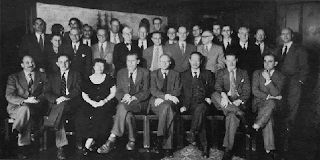
    Photo from the 10th Annual Macy Conference on Cybernetics

    Chapter 1 also introduced the Macy Conference on Cybernetics, which were interdisciplinary meetings held from 1943 to 1954.  "These meetings... were instrumental in forging a new paradigm. To succeed, they needed a theory of information ([Shannon]), a model of neural functioning that showed how neurons worked as information-processing system ([McCulloch]), computers that processed binary code and could... reproduce themselves, thus reinforcing the analogy with biological systems ([von Neumann]), and a visionary who could articulate the larger implications of the cybernetic paradigm and make clear its cosmetic significance (pg 7)."  In Chapter 1, there is also a definition of virtuality, which is defined as the "cultural perception that material objects are interpenetrated by information patterns (pg 13-14)."
    This text focuses heavily on the concept of "information" - what it is, how it should be embodied/materialized (or not), etc. - and therefore fits well with the key concept of Information from Key Concepts and Pattern from Lingua Fracta.  It also fits well with Interface and Interactivity from Key Concepts and Performance from Lingua Fracta. With regard to the layout of the book, it is organized in terms of the three "waves of cybernetics," all of which use the living being as an analogy for the intelligent machine.  The first focuses on homeostasis or feedback loops (pg 8), the second focuses on reflexivity (pgs 9-10), and the third focues on self-organization (artificial life) (pg 11).   

    Chapter 2 was called "Virtual Bodies and Flickering Signifier," and it primarily discussed informatics, and how there is a trend toward considering information in terms of pattern/randomness, as opposed to presence/absence, as well as considering its patterns of transfer.  Flickering signifiers were described by Lacan as being created by information technologies and characterized "by their tendency toward unexpected metamorphoses, attenuations, and dispersions (pg 30)." The author goes on to say that "flickering signification brings together language with a psychodynamics based on the symbolic moment when the human confronts the posthuman." To be honest, I am a little bit confused about what exactly a "flickering signifier" is and what it means, so I need to look into this a little further.

     Chapter 3 was called "Contesting for the Body of Information: The Macy Conferences on Cybernetics."  This chapter introduced the first wave of cybernetics, which focused on the idea of homeostasis and the analogy that can be drawn between feedback loops in living beings and feedback loops in machines as an argument for the disembodied medium as related to information (pg 50-51).  The author referred to Claude Shannon's definition of information "as a probability function with no dimensions, no materiality, and no necessary connection with meaning (pg 52)."


    References

    Hailes, N. Katherine. How We Became Post-Human: Virtual Bodies in Cybernetics, Literature, and Informatics. Chicago, Illinois: The University of Chicago Press, 1999. Print.

    Monday, February 6, 2012

    Social Media Explained...

    (Source: Andrew Katz Facebook)

    Reading, Thinking, & Reflecting Notes - February 6, 2012

    This week's reading assignment was to finish both Lingua Fracta and Do Androids Dream of Electric Sheep?

    I read Chapters 5-7 and the Coda in Lingua Fracta, and one thing that I noticed after reading through the entire book was that it it is really difficult to discuss any one of the canons in isolation without considering how it relates to the others within the given framework.  Chapter 5 covered Perspective (style), Chapter 6 covered Persistence (memory), and Chapter 7 covered Performance (delivery).

    In considering "new media," it seems that the visual elements of "perspective"
    and "style" have been reborn.  This is a graphical representation of Samuel Marolois's
    Mathematical Theory on Perspective (Andersen 2007).  This drawing seems like a good analogy for new media -
    stairways, hallways, and rooms in every direction, often without a concrete destination.
    (Image Source: Royal College of Physicians)
    As a linguist, I found Mary Hocks' (2003) explanation of rhetorical theory as a "dynamic system" coupled with Stafford's (1998) theory that it is rather a "dynamic system of strategies" to make a lot of sense (pg 116.).  When you consider how new media usage is creative yet patterned, it is like the grammar of a language. This debate reminds me of the ongoing battle between the "prescriptivist" and "descriptivist" ways of looking at grammar - there's the "static" book version of grammar, and then there's the "dynamic" way it is actually used... either way you look at it, the usage is patterned!

    I was also interested in the discussion in Chapter 6 about Aristotle and his views on stylized language (pg. 118).  Again, I felt like there was a close connection to a topic I am familiar with - sociolinguistics.  The quote, "The responsibility for avoiding [the risk of excess], for maintaining appropriateness, falls to the rhetor, and it is a responsibility that persists to the present day in our attitudes toward language - from word choice at the barest syntactic level to issues of intellectual property and authorship on a cultural level (pg. 118)" stood out to me because it made me think of concepts that I had studied as a grad student such as language variation and ideology.  Furthermore, Aristotle's (1991) theory of rhetoric placing a distance between the language and its user in that conscious decisions must be made depending on subject, audience, style, etc. reminded me of the linguistic concept of "codeswitching." Then, lo and behold, the author stated that this rhetorical theory, taken with his definition of metaphor could be seen at the "level of code." *enter lightbulb*

    On page 120, Brooke provided a definition of perspective. "Perspective is a method for displaying three dimensional objects and/or scenes on a two-dimensional space." In the same chapter (pg 128), I found another definition that was helpful to me:
    • hypertext - links a passage of verbal discourse to images, maps, diagrams, and sound as easily as to another verbal passage
     Finally, at the conclusion of Chapter 5, I liked how the author tied the conept of "perspective" back to "interface" by stating that the meaning of the interface depends on and is defined by the user's interaction with it.... kind of like in the Matrix!
    
    (Source: Cyber Punk Review)
    I found it interesting how Brooke pointed out how the last two canons, which were presented in Chapters 6 and 7 (memory and delivery), have traditionally fallen by the wayside.  Since rhetoricians have traditionally analyzed static, written texts, the two canons have somehow lost significance.  With the dynamic, ever-changing nature of new media, these canons can be resurrected as Persistence and Performance.

    In Chapter 6, which covered "Persistence," there was an extensive discussion on "memory," which tied well into the material we covered in Chapter 5 of New Media: Key Concepts, "Archive."  I also enjoyed the part about collective history and the role media plays in it.  The author gave the examples of two historically significant events - Rodney King and the Challenger (pg. 149-150).  I was a bit surprised not to see some more recent events, namely those that occurred on 9/11/01, or George W. Bush's "Operation Freedom." Then again, I feel like those events happened during some sort of transisition, when "old media" was starting to take advantage of new technologies such as live streaming in this video, which burned these events in our collective memory (no pun intended):


    More recent historical events awere not only archived by, but driven in real-time, by social media. For example, the Arab Spring of 2011:
    
     This man represents the "youth."  The protest sign speaksof change through social media.
    The sword represents the terrorists and their version of change.
     You can see the man holds the protest sign high as he releases the sword.
    (Translated by ELC Student, Fisal Ahmed)
    (Image: Riccardo Guidi)
    In Chapter 7, one of the points that stood out to me most fell within the topic of "credibility."  As an instructor - especially one in an ESL/Higher Ed setting - web credibility is a significant issue when teaching how to find and cite sources.  I was intrigued by the concept of "distributed credibility," which was introduced on pg. 185.  Distributed credibility can be determined by considering "skillfull design, image quality, usability, information structure, comprehensiveness, absence of self-interest, usefullness," and so on.  I will definitely start incorporating this information into my lessons - I never thought about those things, and always have encouraged my students to only look for names, dates, connections to "real texts," etc.

    I found this video on YouTube that imagines the future "evolution" of Google:


    I wonder how far off we are from this in [virtual] reality?  I think this story embodies many of the concepts we have been considering in the two theoru-based texts we have read together so far in this course.  From the ecologues of practice we looked at in Lingua Fracta to the key concepts (network, information, interface, archive, interactivity, and simulation).   

    I'm very much looking forward to discussing DADoES in class. 

    References

    Andersen, Kristi. The Geometry of an Art: The History of the Mathematical Theory of Perspective from Alberti to Monge. Springer, 2007. Googlebooks. Web. 5 Jan. 2012.

    Brooke, Collin Gifford. Lingua Fracta. Creeskill, New Jersey: Hampton Press, Inc., 2009. Print.

    Dick, Phillip K. Do Androids Dream of Electric Sheep? New York: Del Rey, 1968. Print.